We've won Tech/Digital Business of the Year 2026!
12th Oct 2026
 By Jonny

Meta is giving businesses a new way to interrogate their own marketing data. Meta AI can now connect with Facebook and Instagram business accounts, Meta Ads and Google Workspace, allowing businesses to ask questions about performance in conversational language.
It can analyse organic content, identify advertising patterns, spot creative fatigue, compare performance with similar businesses and suggest where budget might work harder. Businesses can also ask it to produce reports and schedule recurring tasks based on that information.
There is plenty here that we think will be genuinely useful. There is also an important distinction between using AI to help understand advertising performance and allowing the advertising platform to decide what good performance means for your business.
That distinction matters.
More on Meta AI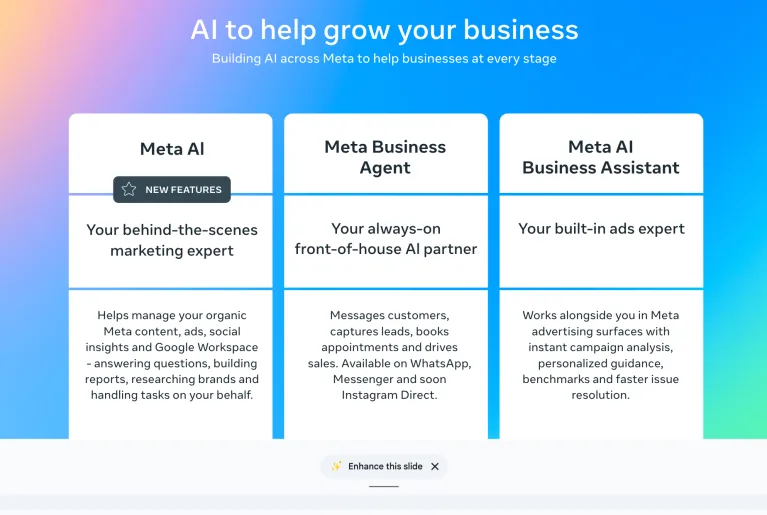
One of the biggest barriers to useful marketing analysis has never been a lack of data. Most businesses already have more data than they know what to do with.
The problem is turning it into something useful.
Meta Ads Manager can tell us an enormous amount about campaign performance, while Facebook and Instagram provide another layer of organic data. The skill comes from knowing where to look, which metrics matter and how different signals relate to the commercial objective.
Conversational AI potentially reduces some of that friction.
Instead of manually building reports to investigate whether a particular type of creative has started losing effectiveness, a marketer could ask Meta AI to analyse recent performance and identify the pattern. It could compare content types, audiences or periods and surface something worth investigating.
Used properly, that can make marketers faster.
Where we’d be more cautious is assuming that faster analysis automatically produces better marketing decisions.
There is an unavoidable tension here.
Meta wants advertisers to achieve results because successful advertisers tend to continue spending money on Meta. At the same time, Meta’s view of success is based largely on the information available within its ecosystem and the data businesses provide to it.
A business might tell Meta that it generated 100 leads at £20 each. On the surface, campaign A producing leads at £15 appears better than campaign B producing them at £30.
What happens if the £30 leads close at four times the rate?
Or campaign A generates plenty of enquiries but the sales team says most are unsuitable?
Or one campaign produces fewer immediate conversions but introduces substantially more valuable customers who purchase repeatedly over the following year?
The advertising interface alone does not necessarily contain enough information to make that judgement.
This is why we would use Meta AI as another analytical tool rather than an autonomous marketing strategist.
One area we’re interested in is creative performance.
Meta says its AI can analyse which audiences are responding, identify patterns in successful content and highlight creatives that have stopped performing effectively.
That could be valuable because creative performance increasingly plays a significant role in paid social results.
Instead of looking only at individual ads, we can start asking broader questions. Are customer-led videos consistently outperforming polished brand creative? Does performance deteriorate after a certain period? Are particular messages working with specific audiences? Are there patterns across organic content that should influence paid creative?
AI can accelerate that investigation.
We would still want a marketer to look at the answer, understand the context and decide what happens next.
Meta AI can also analyse publicly available content and engagement patterns from comparable businesses.
Competitive analysis has obvious appeal, but it is another area where context matters.
A competitor generating substantially more engagement doesn’t necessarily have a better social strategy. They could have a larger existing audience, different objectives, a substantially bigger content budget or an entirely different customer profile.
We would use competitive data to generate questions rather than conclusions.
What formats are appearing repeatedly? What topics seem to generate conversation? Where is everybody in the market saying essentially the same thing? Is there an opportunity for the brand to take a more distinctive position?
Those are strategically useful questions.
Simply trying to imitate whichever competitor has the highest engagement rarely is.
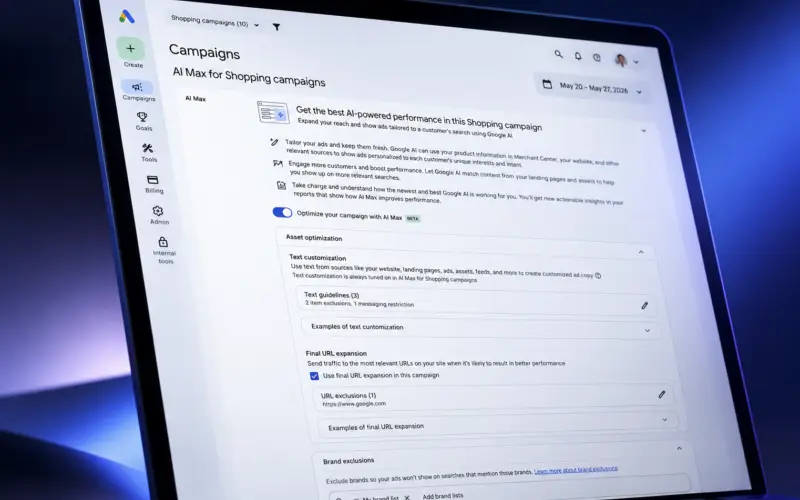
The direction of travel across advertising platforms is clear. Google, Meta and others are moving more analysis, optimisation and execution into AI-powered systems.
We don’t think the sensible response is to reject that automation. There are tasks AI can perform faster than a person and patterns it can uncover across large datasets that could easily be missed manually.
The opportunity is to use those capabilities while retaining the commercial judgement that sits outside the platform.
For Meta AI, we’d use it to investigate performance, surface anomalies, explore creative patterns and accelerate reporting. We’d then compare those findings against the wider picture, including analytics, CRM data, lead quality, sales performance and the actual objectives of the business.
AI can help us understand what happened inside an advertising account.
Deciding what the business should do about it still requires a much wider view.
 By Jason