

We've won Tech/Digital Business of the Year 2026!
12th Oct 2026
 By Jonny

While working inside a live Standard Shopping campaign this week, we spotted something we’ve been waiting to get our hands on.
AI Max for Shopping is now appearing directly within Google Ads accounts, including a new Product titles section showing how Google can dynamically customise the titles shoppers see.
The feature itself isn’t completely new. Google first announced AI Max for Shopping in April 2026 before gradually expanding access throughout the year. What’s more interesting to us now is that we’re moving beyond the announcement stage and into the point where we can actually see and test the functionality within campaigns we’re managing.
Having looked more closely at what’s available, we think there’s a much bigger story here than Google adding another AI feature to Google Ads.
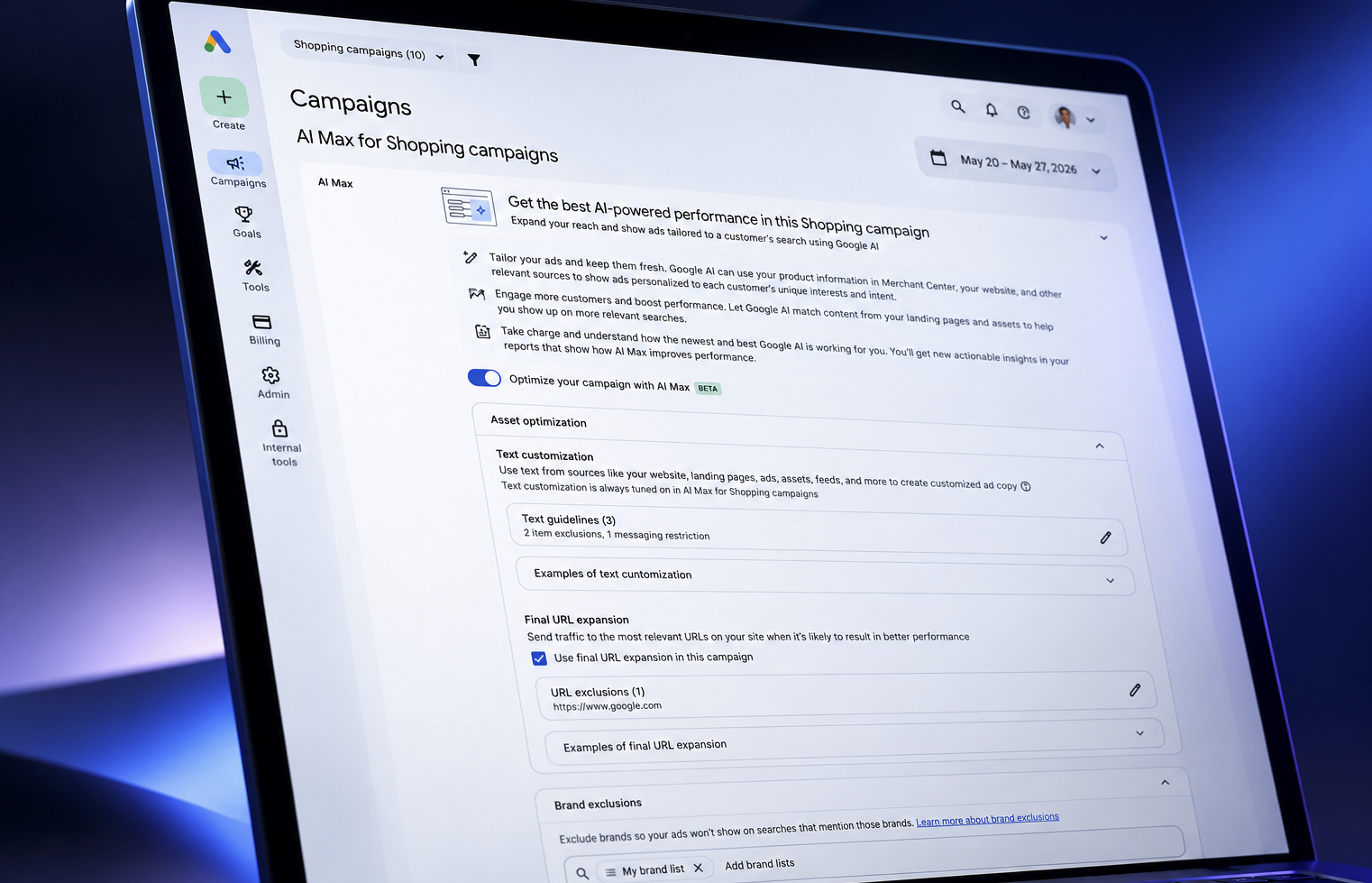
AI Max for Shopping brings additional automation to Standard Shopping campaigns, allowing Google to use more of the information already available within Merchant Center and on an advertiser’s website to decide how a product should be presented for a particular search.
One of the features we’re most interested in is text customisation.
Traditionally, retailers provide Google with a product feed containing information such as the title, description, brand, price, GTIN and other relevant product attributes. That information helps Google understand the product and determine when it might be relevant to a search.
The product title has always been particularly important. When we’re optimising an ecommerce feed, we’ll consider whether the title gives Google enough information about the product and whether important characteristics appear in a useful order.
Depending on the product, that could include the brand, product type, size, colour, material, flavour or another attribute that helps distinguish it from similar products.
The limitation has always been that we’re essentially creating one product title that needs to work across many different searches.
AI Max starts to change that.
With text customisation enabled, Google can use information from the Merchant Center feed to generate an alternative product title that more closely reflects what an individual shopper is looking for.
Google isn’t simply replacing the title supplied by the retailer. Its systems can decide when a customised title is likely to perform better and use the original product title when it isn’t.
For a retailer with hundreds or thousands of products, that has obvious potential. We can optimise a product feed around the information customers are likely to need, but manually creating a different title for every possible variation of search intent isn’t realistic.
AI Max gives Google considerably more flexibility to make that connection itself.
The obvious question is whether dynamic product titles make traditional feed optimisation less important.
We think the opposite is true.
Google still needs reliable information from which to make these decisions. If a Merchant Center feed contains vague titles, weak descriptions, missing attributes or inaccurate product information, there is less useful information available for the system to work with.
The role of the product feed is therefore beginning to change.
Rather than thinking about it simply as a collection of fields that eventually become a Shopping ad, it is more useful to think about the feed as a structured source of product intelligence.
That distinction becomes increasingly important as more of the execution is automated.
If Google decides which attributes are most relevant to a particular search, the advertiser’s job shifts further towards making sure those attributes are complete, accurate and commercially useful in the first place.
This is a pattern we’re seeing across Google Ads more generally. As platforms take greater control over bidding, matching, creative and targeting, the quality of the inputs becomes increasingly important.
Automation doesn’t remove the work. It changes where the valuable work happens.
Text customisation is only part of AI Max for Shopping.
Advertisers can also choose to enable Final URL expansion. Normally, a Shopping ad sends somebody to the product URL supplied through Merchant Center. With Final URL expansion enabled, Google can determine whether another relevant page on the website would provide a better destination for the shopper’s search.
That could mean sending somebody to another relevant commercial page rather than the individual product URL.
Enabling Final URL expansion can also allow the campaign to serve additional text and hybrid ad formats rather than being limited to a conventional Shopping ad.
For us, this requires a different level of consideration.
We’re comfortable testing whether Google can create a more relevant version of a product title from accurate information we’ve already supplied. Giving the system greater control over where somebody lands on the website potentially affects the customer journey as well as the advert.
The useful part is that advertisers don’t have to enable everything at once. Text customisation can be tested without also enabling Final URL expansion.
That gives us a much cleaner way to evaluate what the technology is actually contributing.
The timing of this development makes sense when we look at what is happening to Search itself.
People aren’t limited to short product searches.
Someone looking for dog treats might search for dog training treats. Another shopper could search for small chicken treats I can use for training a puppy.
Both have commercial intent, but the second gives Google considerably more information about what the shopper actually wants.
As Search becomes increasingly conversational through AI Overviews, AI Mode and changing user behaviour, Google needs its advertising systems to understand more nuanced expressions of intent too.
A single static product title cannot possibly reflect every useful variation.
AI Max allows Google to take the information available about a product and adapt how it is presented according to the context of the search.
For retailers, the opportunity is not simply to generate better-looking product titles. It is potentially to connect relevant products with longer and more specific searches that would have been harder to address through a single feed title.
Whether that produces better commercial performance is what we actually want to test.
Google is already reporting performance improvements from AI Max for Shopping.
According to Google’s own global retail advertiser data, advertisers activating AI Max for Shopping typically see around 5% more conversions or conversion value at a similar CPA or ROAS.
It’s an interesting early indication, but we wouldn’t treat it as a prediction of what will happen in an individual account.
The figure comes from Google’s own data; AI Max for Shopping is still in beta, and the quality of the campaign before enabling the feature will inevitably matter.
We’re particularly interested in what happens when AI Max is applied to an already well-managed Standard Shopping campaign with strong product data.
If a poorly structured feed improves performance by 5% with AI Max, that tells us one thing. If it can generate a similar improvement from a mature campaign with an extensively optimised Merchant Center feed, that tells us something considerably more interesting.
That’s the test we’re interested in.
One of our recurring concerns with increased automation in advertising platforms is understanding what the system actually did.
AI Max for Shopping includes controls such as term exclusions, messaging restrictions, brand exclusions, and URL exclusions, but we’re particularly interested in reporting on customised product titles.
The Product titles report allows advertisers to see examples of AI-generated titles that have actually appeared in their ads.
That gives us an opportunity to assess whether Google’s changes make sense rather than simply accepting that automation has improved something because an overall performance number moved.
It could also provide useful insight into how Google interprets the products we’re advertising. If the system repeatedly selects particular attributes or terminology when responding to certain types of search, that may tell us something useful about the relationship between the product data and customer intent.
As platforms automate more decisions, we think this kind of visibility becomes increasingly important.
We wouldn’t switch every AI Max feature on simply because Google has made it available.
Text customisation is the part we’re most interested in testing initially because it allows Google to experiment with query-specific product titles while leaving us with greater control over the destination.
Final URL expansion requires more consideration. If Google can change both the landing page and the format of the advert, we’re changing several parts of the customer journey simultaneously.
We’d also want a reliable baseline before beginning the test.
If we optimise the Merchant Center feed, restructure the campaign, change the bidding strategy and enable AI Max at the same time, any improvement or decline becomes much harder to interpret.
Google recommends allowing AI Max time to learn before making further changes. We’d take the same measured approach and avoid judging the feature on a few days of data.
Most importantly, we’d look beyond whether conversions simply increased.
We’d want to understand which searches were being reached, what titles Google generated, whether conversion quality changed and whether the additional automation produced a commercially meaningful improvement.
For us, AI Max for Shopping is another indication that the relationship between product data, advertising creative and search intent is becoming much more fluid.
Historically, optimising a Shopping feed partly meant optimising the information that would become the advert.
We’re moving towards a model where the feed increasingly provides product intelligence, and Google’s systems decide how to present that information to an individual shopper.
That doesn’t make feed optimisation redundant. We think it makes the quality of the underlying data even more important.
As Google takes greater control over execution, our role increasingly moves towards providing better inputs, setting appropriate commercial boundaries and critically assessing the decisions the automation makes.
AI Max for Shopping is still in beta, so we’re not drawing any major conclusions about its performance yet.
What makes it worth talking about now is that we’re starting to see it appear directly within the Standard Shopping campaigns we’re managing. That gives us the opportunity to move beyond Google’s launch material, test it against real campaigns and see whether the additional automation actually improves the results that matter.
We’ll be watching that closely as we start putting it through its paces.
 By Liam