

We've won Tech/Digital Business of the Year 2026!
12th Oct 2026
 By Jonny

Google Search Console has traditionally told us what happens between a Google search and a website. That definition has now broadened considerably.
Google has introduced platform properties, allowing Instagram, TikTok, X and YouTube accounts to be added directly to Search Console. Once connected, businesses and creators can see how content published on those platforms is being discovered through Google Search, with reporting also extending to Discover and Google News where content appears.
At first glance, this looks like another Search Console reporting update. We think the more interesting part is what sits behind it. Search behaviour is becoming increasingly distributed across websites, social platforms, video, and AI-powered experiences, while Google is surfacing more of those formats in its results.
For marketers, that makes the traditional dividing line between SEO, social media and content increasingly difficult to justify.
Instagram, TikTok, X and YouTube accounts can now be created as individual properties within Search Console, much like we already create properties for websites.
Google initially announced the feature on 7 July 2026 as a gradual rollout. On 29 July, it confirmed that platform properties had become globally available.
Once a social account has been verified, Search Console can provide reporting including:
The standard Performance report provides the more detailed data, while Insights gives a simpler overview of recent trends, successful content and how people are finding the account. Google also supports exporting the performance data for analysis elsewhere.
Importantly, this isn’t reporting how a post performs inside Instagram or TikTok. It tells us how that content performs when it appears within Google’s ecosystem.
That distinction is where much of the value lies.
We have known for some time that Google can surface social and video content in its search results. Until now, understanding what was happening from the publisher’s side has been far less straightforward.
A TikTok video might appear for a valuable search. A YouTube video could continue attracting people months after publication. An Instagram post could start appearing around a topic nobody originally considered when planning it.
Search Console can now expose some of that behaviour.
For us, the query data is particularly useful. Knowing that a video received 20,000 views on its native platform tells us something about its social performance. Knowing the searches people are using when Google presents that video tells us something different about intent.
That information can influence far more than the next social post.
If a particular subject repeatedly generates impressions or clicks, we can investigate whether it deserves a more substantial website article, landing page, video, paid campaign or lifecycle content. Equally, an established website search topic could inform what the social team creates next.
This gives businesses another useful feedback loop between channels that have historically been measured separately.
There will inevitably be plenty of advice about “optimising TikTok for Google” or treating every Instagram caption like a miniature web page.
We would be cautious about going too far in that direction.
Social content still needs to work for the platform and, more importantly, for the people consuming it there. Filling every caption with search terms just because Search Console now provides query data would miss the point.
Instead, we would use the data to understand patterns.
Which subjects repeatedly earn visibility? Which formats appear to work particularly well in search? Are people discovering older content long after its initial social reach disappeared? Are certain queries producing lots of impressions but relatively few clicks? Does short-form video behave differently from longer YouTube content?
Google suggests using the data to compare short- and long-form content, identify older videos regaining traction, and find recent posts experiencing sudden search traffic. It also recommends using Search Console annotations to measure whether changes such as rewriting a YouTube title or TikTok caption affect subsequent search performance.
Those are much more useful applications than simply adding keywords to everything.
For businesses operating across several channels, we think the real value will come from comparing Search Console platform data with information already available elsewhere.
Imagine publishing a series of videos around a product or service. Native social analytics tell us which generated views, watch time and engagement. Search Console can now add another layer by showing which videos Google surfaced, what people searched for and which content earned clicks.
Website Search Console data can then show how the business’s own pages perform for similar searches. GA4 can help us understand what users do after reaching the website. Paid search data can provide another view of commercial demand and conversion behaviour.
Individually, none of these datasets gives us the complete answer. Together, they can provide a much better picture of how people research a subject and interact with a brand across different environments.
This is also why we would resist treating platform properties as something solely for the SEO team. Social media managers, content teams, paid media specialists, and anyone responsible for wider digital strategy can also use this information.
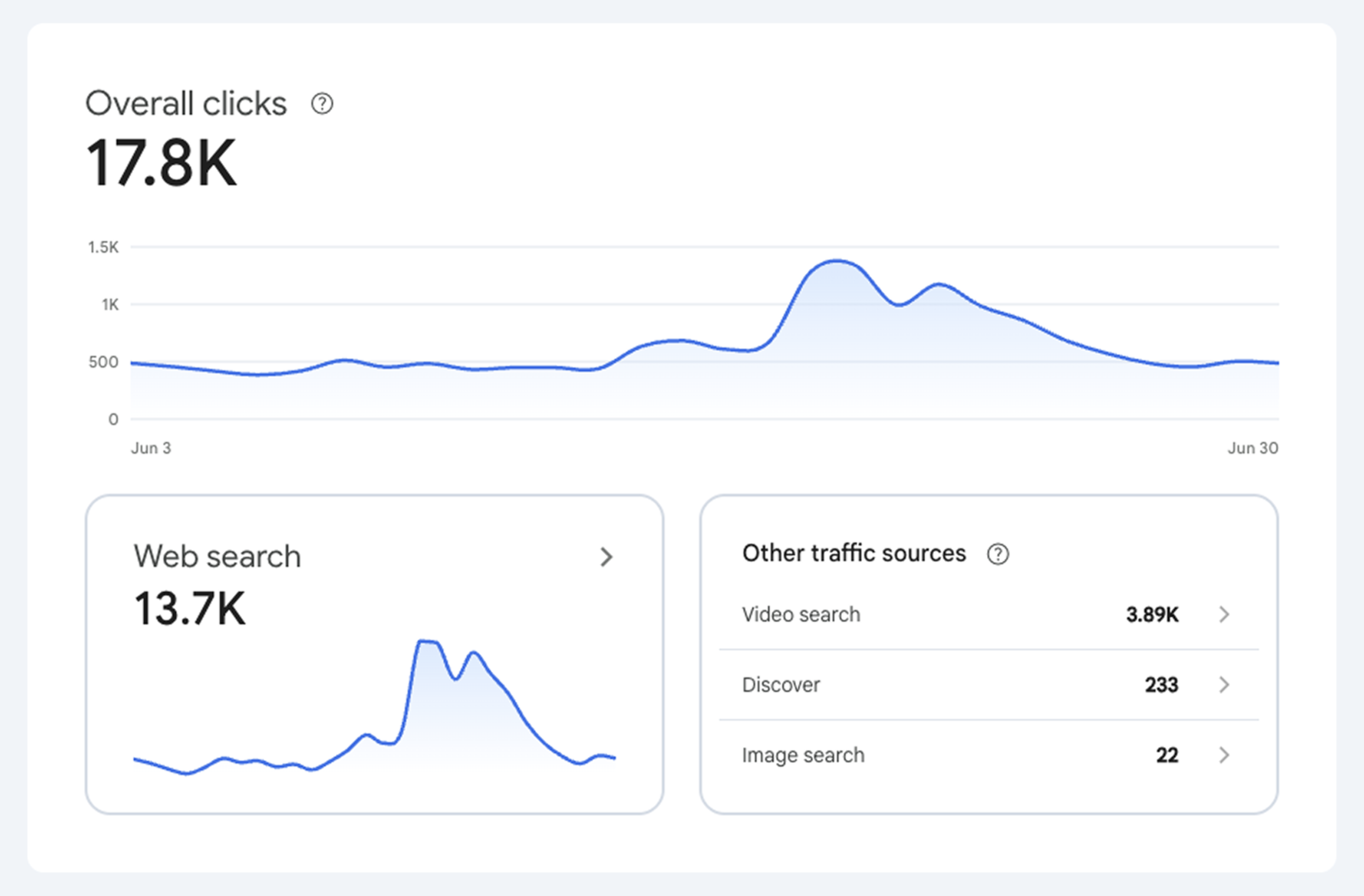
Setting up a platform property is relatively straightforward.
In Search Console:
Each account is treated as its own property, so a business operating across all four supported platforms must add them separately. Google says verification can take place through an existing website property or by logging directly into the relevant platform, depending on the account and setup.
Once verified, it can take a few days for reporting data to appear. Google also periodically checks ownership. If the external connection expires or is lost, access to the platform property pauses until it is verified again, although the existing report is retained.
Once enough data has accumulated, we wouldn’t begin by chasing individual posts with the highest number of impressions. We’d look for repeatable signals.
Search queries are a good starting point because they reveal the language and topics associated with the content. We would then compare those queries with the posts receiving visibility and look for clusters rather than isolated successes.
Next, we would compare those findings with website search performance. If Google consistently surfaces a brand’s videos for a particular subject but its website has little organic visibility in the same area, that could reveal a content opportunity. The reverse is equally useful. Strong website search demand could support investing in more video or social content on the same subject.
We would also monitor older posts. Social reporting naturally focuses attention on what has just been published, whereas search can give useful content a much longer lifespan. Search Console may help identify videos and posts that continue attracting discovery well after they have disappeared from a typical social reporting window.
The significance of platform properties goes beyond having four more icons inside Search Console.
People do not organise their research according to agency service departments. Someone considering a product might search Google, watch a YouTube review, encounter a TikTok video, return to Google, visit the company’s website and eventually convert through another channel entirely.
Our marketing strategies and reporting need to reflect that behaviour.
Google bringing Instagram, TikTok, X and YouTube performance into Search Console gives marketers another way to understand the overlap. It does not make social media an SEO channel and it certainly doesn’t mean every post should now be created for Google.
What it does provide is more evidence about how content travels beyond the platform where it was originally published. For businesses producing significant amounts of social and video content, that is information worth having.
 By Liam