

We've won Tech/Digital Business of the Year 2026!
12th Oct 2026
 By Jonny

Google has made little secret of where it sees the future of Search advertising. It wants its AI to play a bigger role in understanding what people are looking for, finding relevant searches, adapting ad creative, and matching users with the most appropriate pages on a website.
AI Max for Search campaigns is an important part of that shift and Google is now giving advertisers more ways to test it before committing to it more widely. That includes experiments that retain brand and location controls, alongside new capabilities for testing different budgets and return targets across multiple Search campaigns.
For us, the ability to test AI Max properly is more interesting than another debate about whether Google’s increasing automation is good or bad. Businesses don’t need to take a philosophical position on automation. They need to know whether it produces better commercial results in the account they’re actually running.
Traditional Search campaigns give advertisers relatively direct control over the searches they want to target. We choose keywords, match types, negative keywords, advertising messages and landing pages, then use performance data to refine the campaign.
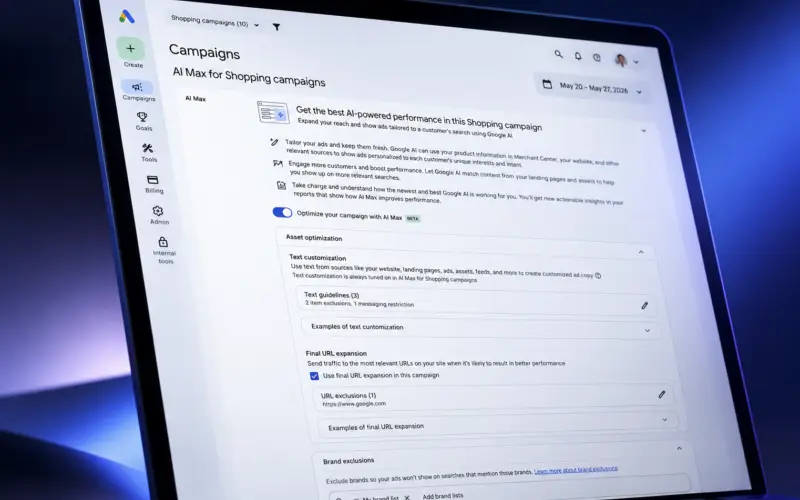
AI Max expands that model by letting Google’s systems use existing keywords alongside ad creative and website content to identify additional relevant searches. Text customisation can adapt messaging to better match a user’s intent, while final URL expansion can direct somebody to a different page on the website when Google believes it provides a better match.
Google has a logical reason for moving in this direction. People don’t all search using the neat phrases sitting inside a keyword list and search behaviour is becoming increasingly conversational and complex. No advertiser can manually anticipate every relevant way somebody might describe a need, product or problem.
That creates a genuine opportunity for AI Max. If Google’s systems can interpret intent beyond the advertiser’s existing keyword set, they may uncover commercially valuable searches that would otherwise have been missed. The question is whether that additional reach translates into better business outcomes rather than simply more activity inside Google Ads.
Google has published encouraging performance figures around AI Max, but platform-wide averages aren’t enough for us to decide whether to roll out a feature across a client’s advertising.
Conditions can differ completely from one account to another. An ecommerce retailer with thousands of products, accurate revenue tracking and significant conversion volume creates a very different environment from a professional services business generating a relatively small number of high-value enquiries each month. A national advertiser also has different requirements from a business serving tightly defined geographical areas.
Website quality, conversion volume, tracking accuracy and the difference in value between individual conversions can all influence whether increased automation performs well. This is why we prefer controlled experiments to wholesale changes based on platform recommendations.
Rather than changing a successful campaign and comparing performance before and afterwards, an experiment gives us a cleaner comparison with the existing setup. Google’s newer controls make that more useful because advertisers can retain important restrictions around brands and locations while testing the additional AI Max functionality.
The obvious measure of an AI Max experiment is whether it generates more conversions at an acceptable cost, but we’d want to understand what those conversions are worth to the business.
For ecommerce, accurate revenue data can provide a relatively clear picture. If AI Max generates more profitable revenue while maintaining an acceptable acquisition cost, there is a strong commercial argument for considering a wider rollout.
Lead generation needs more scrutiny. Imagine the existing campaign generates 50 leads at £40 each while AI Max generates 70 at £32. Looking only at Google Ads, the test appears to have produced an excellent result. If 40% of the original leads become qualified opportunities but only 15% of the AI Max leads do, the commercial picture changes considerably.
This issue becomes more important as advertising platforms automate more decisions. Google can optimise extremely quickly towards the outcome we provide, but if that outcome is simply somebody submitting a form, the system has limited information about what happens afterwards.
A business usually cares about qualified opportunities, sales and revenue rather than the number of forms sitting in an inbox. Where possible, we’d want meaningful CRM or offline conversion data feeding back into the advertising platform so Google’s optimisation better understands what a valuable customer looks like.
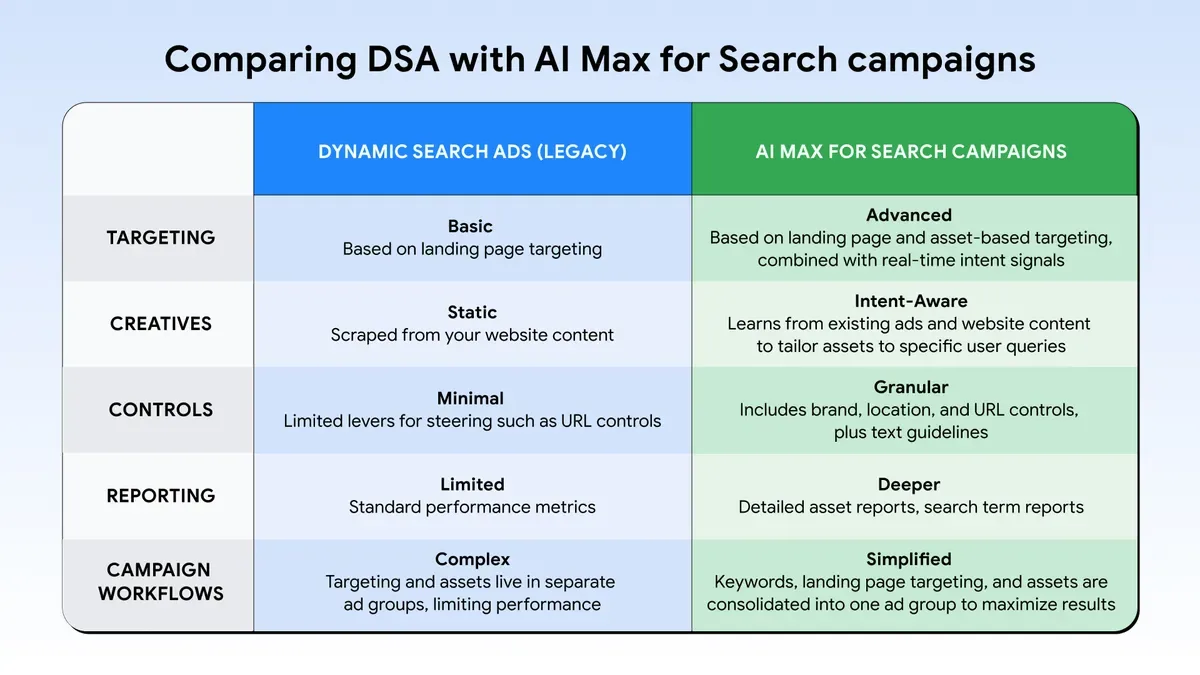
If an AI Max experiment outperforms the original campaign, we’d want to understand where the improvement came from before increasing its role across the account.
Search terms would be one of the first places we’d investigate. If AI Max has discovered additional queries with strong commercial intent, that tells us something useful about demand. We’d also review which pages were selected through final URL expansion, whether adapted advertising remained accurate and whether performance was consistent across the locations and audiences that matter to the business.
An overall improvement can sometimes hide considerable variation underneath it. One particularly strong area might be carrying weaker performance elsewhere, or an increase in conversion volume might be coming from searches that look less convincing when reviewed manually.
This analysis is useful even when the experiment performs well because it gives us information we can use beyond the immediate campaign. An overlooked search theme could influence SEO content, landing pages or future campaign structure. A page repeatedly selected by Google’s systems might reveal something about how customers interpret the business’s proposition, while weaker queries can highlight where additional controls or negative keywords are required.
A good experiment should therefore give us more than a winning percentage. It should improve our understanding of the market and the account.
One consequence of AI Max that deserves more attention is the website's increased importance.
When Google’s systems use website content to understand what a business offers and decide which page best matches a particular search, the website's quality and structure become part of the campaign’s ability to target effectively.
A vague service page gives Google’s systems vague information. Several overlapping pages without a clear purpose can make it harder to understand which destination best satisfies a particular intent. Equally, finding more relevant searches creates little commercial value if those visitors arrive on a page that doesn’t explain the proposition properly or makes conversion unnecessarily difficult.
We would therefore look beyond the Google Ads account before testing AI Max. Important products and services should be clearly represented, landing pages should reflect genuine customer intent and conversion journeys should work properly across devices. The content also needs to accurately represent what the business wants to advertise.
This is a good example of why paid media, SEO, content, analytics and web strategy increasingly need to work together. Greater advertising automation doesn’t reduce the importance of those disciplines. It makes the quality of their inputs more significant.
Google is gradually bringing existing Search functionality under the AI Max umbrella. From September 2026, Search campaigns using automatically created assets and campaign-level broad match are due to begin upgrading automatically to AI Max. Google has extended the migration timetable for Dynamic Search Ads, with that transition now expected to begin in February 2027.
We don’t see that as a reason to switch AI Max on indiscriminately. It is, however, a good reason for advertisers to understand what the technology does, identify which existing campaigns may be affected and decide where a controlled test would provide useful evidence.
There is a significant difference between deliberately running an experiment with clear success criteria and encountering a change to campaign functionality without having properly evaluated its impact. Testing before wider adoption gives marketers a chance to understand the system's strengths and limitations while they still have a clear benchmark against their existing approach.
Google Ads automation isn’t going away and we don’t think advertisers should want it to. Google’s systems can make decisions at a speed and scale no paid media specialist could reasonably replicate manually, while increasingly complex search behaviour makes exhaustive keyword lists less capable of representing every expression of customer intent.
The marketer's role changes as a result. More value lies in deciding where automation makes sense, setting the right boundaries, providing high-quality measurement signals, and judging performance against commercial outcomes rather than managing every campaign input manually.
For AI Max, we’d start with an appropriate campaign and establish what success looks like before the experiment begins. We’d make sure conversion tracking is reliable, retain the controls the business genuinely needs and give the test enough time and data to produce a meaningful result. If it finds valuable demand we weren’t reaching, improves commercial performance and maintains the quality of traffic and conversions, we’d have a strong reason to consider scaling it.
If it doesn’t, we wouldn’t keep it simply because Google recommends it. The most persuasive case for AI Max should come from the advertiser’s own results.
 By Liam